On this page
To get through airport security faster, arrive with the right ID ready, pack your carry-on so liquids and electronics come out in seconds, wear easy clothing with few metal items, and consider a trusted traveler program such as TSA PreCheck. Most delays come from the person in the bin, not the line, so preparation at home pays off.
This list covers what to do before you leave the house, how to pack for the scanner, how to move through the checkpoint itself, and which programs can shorten the wait. It focuses on US airports and the TSA, with notes for travelers flying from the UK, Canada and Australia, where the details differ.
Key takeaways
- Carry an accepted ID. For US domestic flights, that means a REAL ID compliant license or another accepted document such as a passport.
- Pack liquids in one clear bag on top of your carry-on and keep electronics easy to reach.
- Empty your pockets into your jacket or bag before you reach the bins, and wear shoes and belts that come off quickly if asked.
- Trusted traveler programs such as TSA PreCheck and Global Entry can mean shorter lines and fewer items to remove.
- Rules change and vary by airport, lane and country, so check the official security website before every trip.
How early should you arrive for airport security?
Arrive early enough that security is never a rush. Many airlines suggest arriving around 2 hours before a domestic flight and around 3 hours before an international one, but busy airports, holidays and checked bags can push that higher. Check your airline’s advice and the airport’s website for current wait information.
Timing tips that help:
- Check wait times. Many airports post live or typical checkpoint waits online or in their apps.
- Avoid peak hours when you can. Early mornings and late afternoons on weekdays are often busy with business travelers, and holiday weekends are busy all day.
- Check in online and download your boarding pass so you can go straight to security if you only have a carry-on.
- Drop bags quickly by tagging them at a kiosk or using online bag check where your airline offers it.
- Know your terminal. Some airports have several checkpoints, and one may be much quieter than another.
For a full timeline of what to do in the days and hours before you fly, see our airport checklist: what to do before your flight.
What ID do you need to get through security quickly?
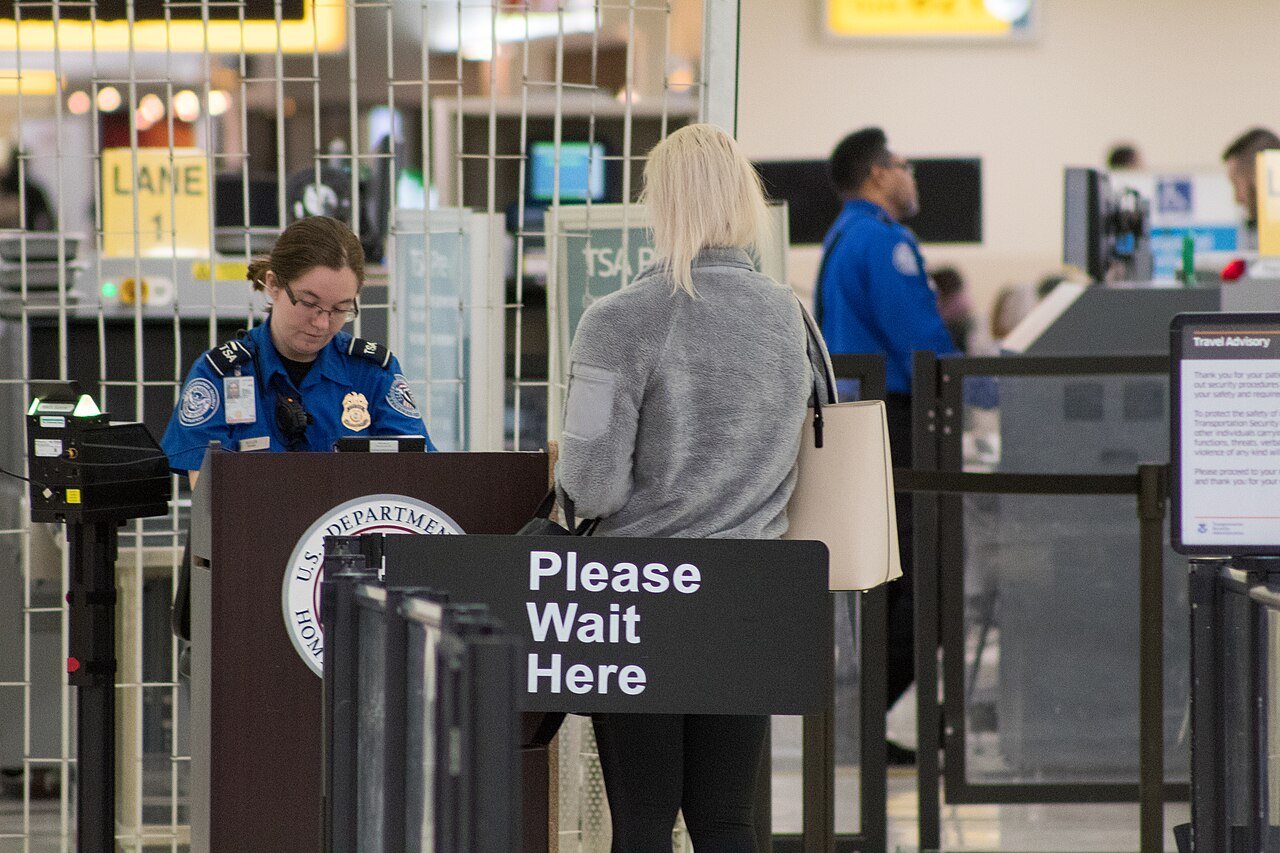
To get through US airport security quickly, carry an accepted photo ID that matches the name on your booking. Since REAL ID enforcement began in May 2025, adults need a REAL ID compliant driver’s license or another TSA-accepted ID, such as a valid passport, for domestic flights. International travelers need a passport.
How to make the ID check fast:
- Check your license. A REAL ID compliant license usually shows a star marking in the top corner.
- Match the name. The name on your booking should match your ID. Fix spelling problems with the airline before travel day.
- Keep it in hand. Have your ID and boarding pass ready before you reach the officer, not buried in a bag.
- Know the alternatives. A passport or passport card is accepted for domestic flights, which helps if your license is not compliant.
For international trips, our international travel checklist of documents to bring covers passports, visas and other papers. It is also smart to store copies safely, as explained in our guide on how to keep copies of your travel documents. Check the latest ID rules at tsa.gov.
How should you pack your carry-on for faster screening?
Pack your carry-on for faster screening by putting your liquids bag on top, keeping electronics in an easy-to-open pocket, and avoiding clutter that makes the X-ray image hard to read. Officers pull bags for extra checks when items are dense, tangled or unclear, so a tidy bag usually moves through without a second look.
1. Follow the liquids rule exactly
In the US, the TSA 3-1-1 rule limits liquids, gels and aerosols in carry-ons to containers of 3.4 ounces (100 milliliters) or less, all in one quart-size clear bag per passenger. Put that bag at the top of your carry-on so you can pull it out quickly if asked.
2. Keep electronics reachable
Pack your laptop and tablet where you can slide them out without unpacking. Standard lanes often ask you to remove larger electronics, while some newer scanners and PreCheck lanes do not. Follow the signs and the officer’s instructions.
3. Pack in layers, not piles
Flat, organized layers create a clearer scan. Group cables and chargers in one pouch, and avoid stuffing many dense items, such as books and food, into one corner.
4. Leave prohibited items at home
Check the TSA “What Can I Bring?” tool for anything you are unsure about. Common slowdowns include pocket knives, large liquids, tools and gel packs that are not frozen solid.
5. Do not wrap gifts
Officers may need to look inside. Bring gifts unwrapped or in gift bags.
Our guide on how to pack a carry-on bag covers packing in more detail, and the carry-on only packing list helps if you travel light.
Tip: Keep a permanent, refilled toiletry bag that already meets the liquids rule. Toss it in your carry-on for every trip and you will never repack bottles at the airport again.
What should you wear to get through airport security faster?
Wear simple clothing to get through airport security faster: shoes that slip on and off easily, few or no metal accessories, a belt without a large buckle or no belt at all, and layers you can remove quickly if asked. The fewer items that set off the scanner, the less likely you are to need a pat-down.
6. Choose easy shoes
Slip-on shoes save time when shoe removal is required. Requirements can vary by lane and change over time, so follow the officer’s instructions.
7. Skip the metal
Leave heavy jewelry, large belt buckles, and clothing with metal studs or many zippers for after the flight, or pack them in your bag.
8. Pocket-free travel
Put your phone, keys, coins and wallet into your jacket or bag before you reach the bins. Empty pockets mean no surprises in the body scanner.
9. Wear a removable outer layer
Heavy coats and bulky jackets usually go through the X-ray. A light jacket you can take off in seconds saves time.
How do you move through the checkpoint itself without delays?
Move through the checkpoint without delays by preparing everything before you reach the bins: ID and boarding pass in hand, pockets empty, liquids and electronics ready to come out if needed, and jacket off. Place items in bins in the order you will pick them up, then step aside to repack so the line keeps moving.
Steps at the checkpoint:
- Watch the people ahead and read the signs so you know what that lane requires.
- Grab enough bins for your bag, jacket, liquids and electronics.
- Load bins efficiently. Put shoes and jacket in one bin, small items in another, and the bag directly on the belt if allowed.
- Listen to instructions about the scanner and stand as directed.
- Collect everything and move to the repacking area before putting shoes back on.
- Check the belt for anything left behind, especially phones and laptops.
If your bag is pulled for a check, stay calm and polite. Answer questions simply. A secondary check is routine and usually quick when the bag is organized.
Which programs help you get through security faster?
Trusted traveler programs help you get through security faster by giving you access to dedicated lanes and, in many cases, fewer screening steps. In the US, TSA PreCheck is the main expedited screening program, and Global Entry includes PreCheck benefits along with faster customs on return from abroad. Each has its own application, fee and eligibility rules.
| Program | What it helps with | Best for |
|---|---|---|
| TSA PreCheck | Expedited US security lanes, often fewer items to remove | Frequent domestic flyers |
| Global Entry | Faster US customs on return plus PreCheck benefits | Frequent international travelers |
| NEXUS | Expedited US and Canada border crossing, includes PreCheck benefits | Travelers between the US and Canada |
| CLEAR | Private identity verification lane at participating airports | Frequent flyers at airports that offer it |
| Airline priority lanes | Separate security line at some airports | Elite status or premium tickets |
Things to know before you apply:
- Check eligibility on the official program website. Not everyone qualifies.
- Add your Known Traveler Number to every booking, or your boarding pass may not show the PreCheck indicator.
- Expect occasional standard screening. Expedited screening is never guaranteed on every trip.
- Apply well ahead of a big trip, since processing and interviews can take time.
Fees and terms change, so check the current details at tsa.gov and cbp.gov rather than relying on older articles.
What are common mistakes that slow down airport security?
Common mistakes that slow down airport security include forgetting liquids in your bag, carrying full water bottles, wearing lots of metal, leaving items in pockets, packing prohibited items, and waiting until the bin to start unpacking. Each one can mean a rescan, a bag check or a pat-down, which takes far longer than a minute of preparation.
- Full water bottles. Empty them before security and refill airside.
- Hidden liquids. Sunscreen, lip gloss and snow globes count. Put them in the clear bag or check them.
- Forgotten pocket items. Coins, keys and phones cause rescans.
- Cluttered bags. Tangled cables and dense food piles make images hard to read.
- Wrong ID. An expired or non-compliant ID can stop you entirely.
- Missing Known Traveler Number. No number on the booking can mean no PreCheck lane.
- Rushing at the end. Arriving late adds stress and mistakes.
How is airport security different outside the US?
Airport security outside the US follows similar principles but different rules. Liquid limits, electronics removal, ID checks and expedited lanes vary by country and even by airport, especially as newer scanners are introduced. Always check the rules for the airport you are departing from, including your return flight.
Regional notes:
- United Kingdom: liquid and electronics rules have changed at some airports as new scanners are introduced, and they may differ between airports. Check your departure airport’s website and gov.uk.
- Canada: the Canadian Air Transport Security Authority (CATSA) sets screening rules, and NEXUS members may have access to dedicated lanes at some airports.
- Australia: screening rules are set nationally and may differ for domestic and international flights. Check the official guidance before you fly.
Connecting flights can mean screening again, sometimes under different rules than your first airport. If you are flying internationally, building extra time into your connection helps. Travel insurance can help with some costs if delays cause you to miss a connection, depending on your policy. Our guide on how to choose travel insurance explains what to look for.
How do you build a fast airport security routine?
Build a fast airport security routine by turning preparation into a repeatable checklist: confirm your ID and boarding pass, pack liquids and electronics in the same spots every time, dress simply, and empty pockets before the line. When the routine is the same on every trip, security becomes quick and predictable.
A simple routine to save in your phone:
- The night before: check in online, confirm your ID, and pack the liquids bag on top.
- Leaving home: move keys, coins and wallet into your bag.
- At the airport: check wait times and choose the quickest checkpoint.
- In line: take out your ID and boarding pass and remove your jacket.
- At the bins: follow the lane’s rules, load bins in order and step through.
- After screening: repack away from the belt and check you have everything.
Security is one piece of a smooth travel day. For your next step, put it in context with our guide on how to plan a trip step by step, and keep chargers and cables organized with our travel tech essentials guide.
Frequently asked questions
How can I avoid long airport security lines?
Fly at less busy times when possible, check airport wait times before leaving, and use the least crowded checkpoint if your terminal has more than one. Trusted traveler programs such as TSA PreCheck often have shorter lines. Arriving early and checking in online also helps, because you can go straight to security without stopping at the counter.
Is TSA PreCheck worth it for occasional travelers?
It depends on how often you fly and how much you value shorter lines and easier screening. Travelers who fly several times a year often find it worthwhile. Membership lasts several years, so compare the current fee and terms on tsa.gov with your plans. If you also travel internationally, Global Entry includes PreCheck benefits.
Do I have to take my laptop out at airport security?
It depends on the lane and the scanner. Standard US lanes often ask you to remove laptops and larger electronics, while TSA PreCheck lanes and some newer scanners do not. Follow the signs and officers at your checkpoint. Pack your laptop where you can remove it quickly so it never slows you down.
Can I bring an empty water bottle through airport security?
Yes. Empty water bottles are generally allowed through US airport security, and you can fill them at fountains or bottle filling stations once you are airside. A full bottle will need to be emptied or thrown away at the checkpoint, so drink or pour out the water before you reach the line.
What happens if my bag is pulled for extra screening?
An officer will check the bag, sometimes by hand and sometimes by swabbing items for testing. Stay calm, answer questions simply and let the officer handle your belongings. Extra screening is routine and not an accusation. A well-organized bag with liquids and electronics easy to see usually makes the check faster.
Sources and further reading
Featured photo: Michael Ball via Openverse (CC0).