On this page
A daypack is a smaller pack built to carry what you need for a single outing, usually with a light frame or none at all. A hiking backpack, in the sense most people mean, is a larger pack with a real frame and a load-bearing hip belt, made for overnight and multi-day trips. Pick by the heaviest load you will carry and the longest trip you plan.
The two categories overlap more than store shelves suggest. A big daypack can handle a fast overnight in summer, and a small framed pack can be a comfortable choice for long winter day hikes. This guide compares them side by side so you can see where each one fits, what the trade-offs are, and how to decide without buying twice.
Key takeaways
- Daypacks are usually around 15 to 35 liters and suit trips where you come home the same day.
- Hiking backpacks for overnight and multi-day trips usually start around 40 liters and add a frame and padded hip belt.
- Weight carried matters more than volume: once your load gets heavy, a frame and hip belt move it to your hips.
- A large daypack can work for light overnights in good weather, but most beginners are more comfortable with a framed pack.
- Fit beats features. Torso length and hip belt fit decide comfort on the trail.
What is the difference between a daypack and a hiking backpack?
The main difference between a daypack and a hiking backpack is load. A daypack carries water, snacks, layers and the essentials for a single outing. A hiking backpack carries all of that plus shelter, sleep gear, food and cooking kit, so it needs more volume, a stiffer frame and a hip belt that carries real weight.
Volume is the number people notice first, but structure is the bigger change. As your load grows, a pack needs a way to move weight off your shoulders. That is the job of the frame, the framesheet or stays, and the padded hip belt. A daypack can skip most of this because the load is light enough for your shoulders to manage.
Here is how the two compare on the features that matter most.
| Feature | Daypack | Hiking backpack |
|---|---|---|
| Typical volume | About 15 to 35 liters | About 40 liters and up |
| Trip length | Same day | Overnight to multi-day |
| Frame | None, foam sheet or light wire | Internal frame, stays or framesheet |
| Hip belt | Thin webbing or light padding | Padded, load-bearing |
| Torso sizing | Often one size or a small range | Sized or adjustable torso |
| Load carried | Light | Moderate to heavy |
| Access | Top zip or panel opening | Top loading, often with side or front access |
The table shows a pattern: everything on a hiking backpack exists to carry weight well over long distances. Everything on a daypack exists to stay light and simple. If you want a deeper look at how volume is measured and what fits in each size, read our guide to backpack capacity explained.
When is a daypack the right choice?
A daypack is the right choice when you start and finish your outing on the same day and your load stays light. That covers most local trail hikes, park visits, city sightseeing and short scrambles. If everything you need fits without strapping gear to the outside, a daypack is usually lighter, cheaper and easier to live with.
Daypacks shine because they get out of the way. They sit close to your back, they are quick to grab from the closet, and they double as a travel or commuter bag on rest days.
Good situations for a daypack include:
- Half day and full day hikes on marked trails in fair weather.
- Summer outings where you carry water, snacks, sun protection and a light layer.
- Travel days where you want a personal item that also works on a trail.
- Kids’ hikes, where an adult carries the shared extras.
- Trail runs or fast hikes, where a smaller running vest or small pack keeps things stable.
Even on a short hike, you should still carry the basics. Our breakdown of the Ten Essentials for hiking explained is a good starting point for what belongs in any pack, no matter how small.
How big should a daypack be?
Many hikers find that roughly 18 to 25 liters covers most summer day hikes, while 25 to 35 liters is more comfortable for winter, long days or when you carry gear for kids. If you often strap a jacket to the outside, that is a sign you need a bit more room.
When do you need a hiking backpack instead?
You need a hiking backpack when you sleep outside or when your day load gets heavy. Carrying a tent, sleeping bag, pad, stove and extra food changes how a pack has to work. A frame and padded hip belt shift most of that weight to your hips, which keeps your shoulders and neck from doing all the work.
The jump in comfort is real once you pass a certain load. Shoulders tire fast, and a frameless pack loaded with heavy, bulky gear tends to sag and pull backward. A framed pack holds its shape, keeps weight close to your spine and gives you adjustment points to tune the carry.
Choose a hiking backpack when:
- You plan overnight or multi-day trips.
- You carry a lot of water, for example on dry trails with few refill points.
- You hike in winter and carry insulated layers, traction devices and more food.
- You carry shared group gear, such as a first aid kit and stove for others.
- You want room to grow into longer trips over the next few seasons.
For a full walk through of features, materials and sizing for multi-day packs, see how to choose a travel backpack, which covers many of the same decisions from a travel angle.
How does weight change the decision?
Weight carried is the clearest way to decide between a daypack and a hiking backpack. Volume tells you what fits, but weight tells you what feels good after several hours. Light loads ride well on shoulders alone, while heavier loads need a frame and a load-bearing hip belt to stay comfortable and stable on uneven ground.
Most pack makers list a comfortable load range, and it is worth reading. When you exceed the range a pack was designed for, it can still hold the gear, but it will not carry it well. Straps dig in, the pack barrels out, and your posture changes to compensate.
A practical way to check your own needs:
- Pack everything you would take on your longest typical trip.
- Weigh the full pack on a bathroom scale by weighing yourself with and without it.
- Compare that number with the load range listed for the packs you are considering.
- Walk around with the full pack for at least 20 minutes, ideally on stairs or a hill.
- Notice where pressure builds. Shoulder pain suggests you need a better hip belt or a frame.
Tip: If a store will not let you load a pack with weight, bring your own gear in a bag and ask to fill the pack yourself. Empty packs all feel comfortable.
Can you use a daypack for an overnight trip?
You can use a large daypack for an overnight trip if your gear is compact and the weather is mild. This works best with a small sleeping bag, a lightweight shelter and simple food that needs little cooking. For most beginners, though, a framed pack is more comfortable and leaves room for the extra layers that safe overnights often need.
Overnights in a daypack are common among people who have spent years refining a light kit. They usually rely on gear that packs small and weighs little. If you are building your first camping setup, your gear is likely bulkier, and a daypack will fill quickly.
Signs a daypack overnight will be a struggle:
- You need to strap your sleeping pad or tent to the outside.
- The pack bulges so much that it pushes away from your back.
- You have to leave behind a warm layer or rain gear to make things fit.
- Your shoulders ache within the first hour.
If any of these apply, it is safer and more comfortable to use a framed pack. Leaving warm layers at home to save space is never a good trade.
Can you use a hiking backpack for day hikes?
You can use a hiking backpack for day hikes, and some people do, especially in winter or on long routes. The downside is extra weight and bulk you do not need. Many larger packs compress well with side straps, but an empty frame and thick hip belt still add weight that a daypack would not.
Some hikers own one pack and make it work for everything. That is a reasonable approach on a tight budget. If you go this way, look for a pack with good compression straps so a small load does not shift around inside. A removable lid can also cut weight and bulk on short outings.
When a big pack makes sense for a day hike:
- Winter hikes with heavy layers, traction and a thermos.
- Long training hikes where you deliberately carry more weight.
- Guided or group hikes where you carry shared gear.
- Routes where you carry several liters of water.
How do frames, hip belts and back panels compare?
Frames, hip belts and back panels are where daypacks and hiking backpacks differ most. Daypacks often use a foam sheet or a light wire for shape, a thin belt for stability and a mesh or foam back. Hiking backpacks use stays or a framesheet, padded belts and adjustable harnesses to transfer weight to your hips.
Frame types
- Frameless: a simple sack with straps. Very light, best for small, soft loads.
- Framesheet: a plastic or foam sheet that gives shape and some support.
- Internal frame: aluminum stays or a perimeter frame inside the pack that carry heavier loads.
Hip belts
On a daypack, the belt mostly stops the pack from swinging. On a hiking backpack, it is the main load-bearing part. A good belt wraps around the top of your hip bones and carries most of the weight when the pack is adjusted correctly.
Back panels
Mesh panels that hold the pack away from your back improve airflow and help in heat. Foam panels sit closer and can feel more stable on rough ground. Neither is better in every case. Pick based on how much you sweat and how technical your trails are.
What features matter on each type?
The features that matter depend on how you will use the pack. On a daypack, focus on easy access, water storage and a comfortable harness. On a hiking backpack, focus on torso fit, hip belt fit, load range and how you organize gear. In both cases, fewer well-placed features usually beat a long list of pockets.
| Feature | Why it matters on a daypack | Why it matters on a hiking backpack |
|---|---|---|
| Hydration sleeve | Easy sipping on the move | Same, but often paired with bottles |
| Side bottle pockets | Quick access to water | Reachable without removing the pack |
| Hip belt pockets | Snacks and phone | Snacks, map and small essentials |
| Compression straps | Stops a small load from shifting | Stabilizes a heavy load |
| Rain cover | Optional in fair weather | Often useful on longer trips |
| Lid or top pocket | Small items | Organization and extra volume |
| Sleeping bag zone | Not needed | Helpful for organization |
If you are weighing a few specific packs, our guide on how to compare travel backpacks gives a simple side by side method that also works for hiking packs.
How should each pack fit?
A daypack and a hiking backpack should both sit close to your back without pressure points, but fit matters more on a hiking backpack because of the weight. Measure your torso length, then check that the hip belt sits on your hip bones and the shoulder straps wrap smoothly with no gaps.
For a daypack, a quick check is enough:
- Load the pack with a typical day of gear.
- Tighten the shoulder straps until the pack sits snug against your back.
- Clip the sternum strap across your chest at a comfortable height.
- Walk briskly and twist your upper body to check for sway.
For a hiking backpack, the process is more detailed and starts with your torso measurement, not your height. We cover every step in how to fit a hiking backpack, including how to adjust load lifters and where the hip belt should sit.
What are common mistakes when choosing between them?
Common mistakes when choosing between a daypack and a hiking backpack include buying by volume alone, ignoring torso fit and choosing a pack for a trip you might take one day instead of the trips you take now. Each mistake leads to a pack that feels wrong on the trail or never leaves the closet.
- Choosing by liters only. Two packs with the same volume can carry very differently.
- Buying too big. A large pack tempts you to carry more than you need.
- Buying too small. If gear hangs off the outside, it snags, swings and gets wet.
- Skipping the fit check. Torso length matters, especially on framed packs.
- Ignoring the load range. Overloading a daypack makes even short hikes tiring.
- Forgetting the essentials. A small pack is no reason to leave rain gear or a light at home.
Tip: Write down the three trips you are most likely to take this year. Choose the pack that suits those trips best, not the dream trip you might take later.
Which should a beginner buy first?
Most beginners should buy a daypack first because day hikes come before overnights for nearly everyone. A comfortable daypack in the 20 to 30 liter range covers a wide range of outings and helps you learn what you actually carry. Buy a framed hiking backpack later, once you know you will camp regularly.
This order also saves money. Your first season of day hikes teaches you what gear you rely on and how you like to organize it. When you move to overnights, you will make better choices about volume, frame style and features because you will know your own habits.
There are exceptions. If your first planned trip is an overnight, or you plan to hike mostly in winter, starting with a framed pack can make sense. Renting a pack for your first overnight is another good option, since it lets you try a framed design before you commit.
A simple decision summary:
| If you mostly… | Start with |
|---|---|
| Hike a few hours at a time | A daypack around 20 to 30 liters |
| Hike long summer days | A daypack around 25 to 35 liters |
| Hike in winter | A larger daypack or small framed pack |
| Plan overnights soon | A framed hiking backpack |
| Travel and hike on the same trip | A daypack that also works as a personal item |
Your next step is to look at capacity in more detail. Read backpack capacity explained to match liters to the trips on your list.
Frequently asked questions
What size is considered a daypack?
Most daypacks fall somewhere around 15 to 35 liters, though there is no strict industry cutoff. Smaller packs suit short summer hikes, and larger ones handle long days, winter layers or shared gear. If you regularly need more than about 35 liters, a framed hiking backpack will usually carry the load more comfortably.
Is a 40 liter backpack a daypack?
A 40 liter backpack is usually treated as an overnight or light multi-day pack rather than a daypack. Some hikers use one for long winter day hikes because of the extra room for layers. Check whether it has a real frame and padded hip belt, since those features suggest it was designed for heavier loads.
Do daypacks need a hip belt?
Daypacks benefit from a hip belt even if it is simple webbing, because it keeps the pack from swinging on uneven ground. On a light daypack, the belt mainly adds stability. A padded, load-bearing belt becomes much more important once you carry heavier loads, such as several liters of water or winter gear.
Can one backpack work for both day hikes and overnights?
One backpack can work for both if it compresses well and fits your torso correctly. A pack in roughly the 35 to 45 liter range with good compression straps is a common compromise. It will feel a little large on short hikes and a little small on longer trips, so it suits people who hike often but keep gear light.
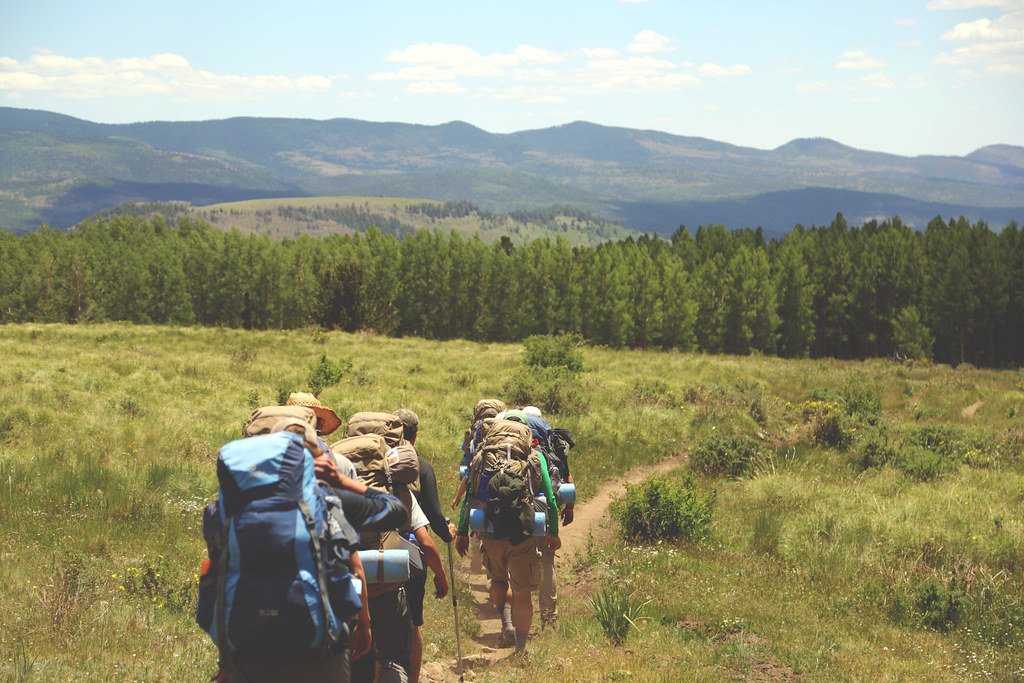
Featured photo: Image Catalog via Openverse (CC0).