On this page
Stand-up paddleboarding for beginners comes down to three things: a stable board, calm and sheltered water, and a simple routine of kneeling first, then standing with your feet hip width apart. Most people can stand and paddle in a straight line within their first session if they pick the right day and keep their expectations modest.
This guide walks you through the gear you need, how to get up on the board, how to hold and use the paddle, how to fall safely and climb back on, and how to choose conditions that set you up for success. It is written for complete beginners in the US, with notes that also apply in the UK, Canada and Australia.
Key takeaways
- Start on flat, sheltered water with little wind, such as a small lake or a protected bay.
- Choose a wide, stable all-around board and a paddle sized a few inches above your height.
- Wear a life jacket and a leash every time, and tell someone where you are going.
- Kneel first, then stand in one smooth move, keeping your eyes on the horizon, not your feet.
- Paddle with the blade angled forward and use your core and hips, not just your arms.
- Expect to fall. Practice falling away from the board and climbing back on in shallow water.
What is stand-up paddleboarding and is it good for beginners?
Stand-up paddleboarding, often shortened to SUP, means standing on a large, buoyant board and moving across the water with a single long paddle. It is one of the most beginner friendly water sports because the board is stable, the stroke is simple, and you can start on your knees until your balance builds.
You do not need to be an athlete. If you can swim, stand on one foot for a few seconds and carry a moderately heavy object, you have what it takes to start. The learning curve is short on calm water and much steeper on windy or choppy days, which is why conditions matter more than fitness at first.
SUP also sits nicely alongside other easy outdoor sports. If you are still deciding what to try, our roundup of beginner outdoor activities to try compares paddling with hiking, cycling and more.
How does SUP compare with kayaking?
Both are great first paddle sports, but they feel different. A kayak keeps you seated and low, which feels secure in wind. A paddleboard puts you higher, gives you a better view and works your balance and core more.
| Factor | Stand-up paddleboard | Sit-on-top kayak |
|---|---|---|
| Position | Standing or kneeling | Seated |
| Balance demand | Moderate to high | Low |
| Handling in wind | Harder, you act like a sail | Easier |
| Getting back on after a fall | Simple on calm water | Simple on calm water |
| Storage and transport | Inflatable boards pack small | Usually needs a roof rack |
| Best first day | Calm, sheltered water | Calm, sheltered water |
If you are torn between the two, our guide to kayaking for beginners and what to know before your first paddle covers the seated option in detail.
What gear do you need for paddleboarding?
Beginner paddleboarding gear is short and simple: a board, a paddle, a leash, a life jacket and clothing suited to the water temperature. Renting all of it for your first few sessions is a smart way to learn what you like before buying anything, and most rental shops will size the board and paddle for you.
Board
For a first board, look for an all-around shape. These are wide, have a rounded nose and are designed for stability on flat water rather than speed. Wider boards are more stable but slower. Longer, narrower boards track straighter and glide faster but feel tippier.
You will see two main construction types:
- Inflatable boards pack into a bag, store in a closet and handle bumps well. They need pumping up before each session.
- Hard boards (often epoxy or foam) feel stiffer and glide well, but they need roof racks and more storage space.
Every board has a weight capacity. Check that your body weight plus anything you carry sits comfortably within it, since a board near its limit sits lower in the water and feels less stable.
Paddle
A common rule of thumb is a paddle roughly 6 to 10 inches taller than you for flat water touring. Adjustable paddles are ideal for beginners because you can fine tune the length as you learn, and they suit more than one person.
Leash
A leash connects your ankle or calf to the board. If you fall, the board stays close instead of drifting away in the wind. On flat water a coiled leash is common. In rivers with current, quick release waist leashes are used because an ankle leash can snag, so take a lesson before paddling moving water.
Life jacket
Wear a properly fitted life jacket. In the US, the Coast Guard classifies a paddleboard used outside a designated swimming, surfing or bathing area as a vessel, which brings life jacket rules into play. State rules also vary, so check the US Coast Guard boating safety site and your state agency before you go. In the UK, Canada and Australia, local rules and guidance differ too, so look up the official boating authority for where you plan to paddle.
Clothing
Dress for the water, not the air. Quick drying synthetic layers, a sun hat with a strap, sunglasses with a retainer and water shoes all help. When the water is cold, a wetsuit or drysuit matters far more than what you would wear on land.
| Item | Why it matters | Beginner tip |
|---|---|---|
| All-around board | Stability while you learn | Rent first, buy later |
| Adjustable paddle | Correct length is easier on your body | Set it a few inches above your height |
| Leash | Keeps the board close after a fall | Ankle leash on flat water |
| Life jacket | Keeps you afloat if you are tired or hurt | Wear it, do not just carry it |
| Sun protection | Water reflects sunlight | Hat, sunscreen, sunglasses strap |
| Whistle | Signals for help | Clip it to your life jacket |
Where should beginners go paddleboarding?
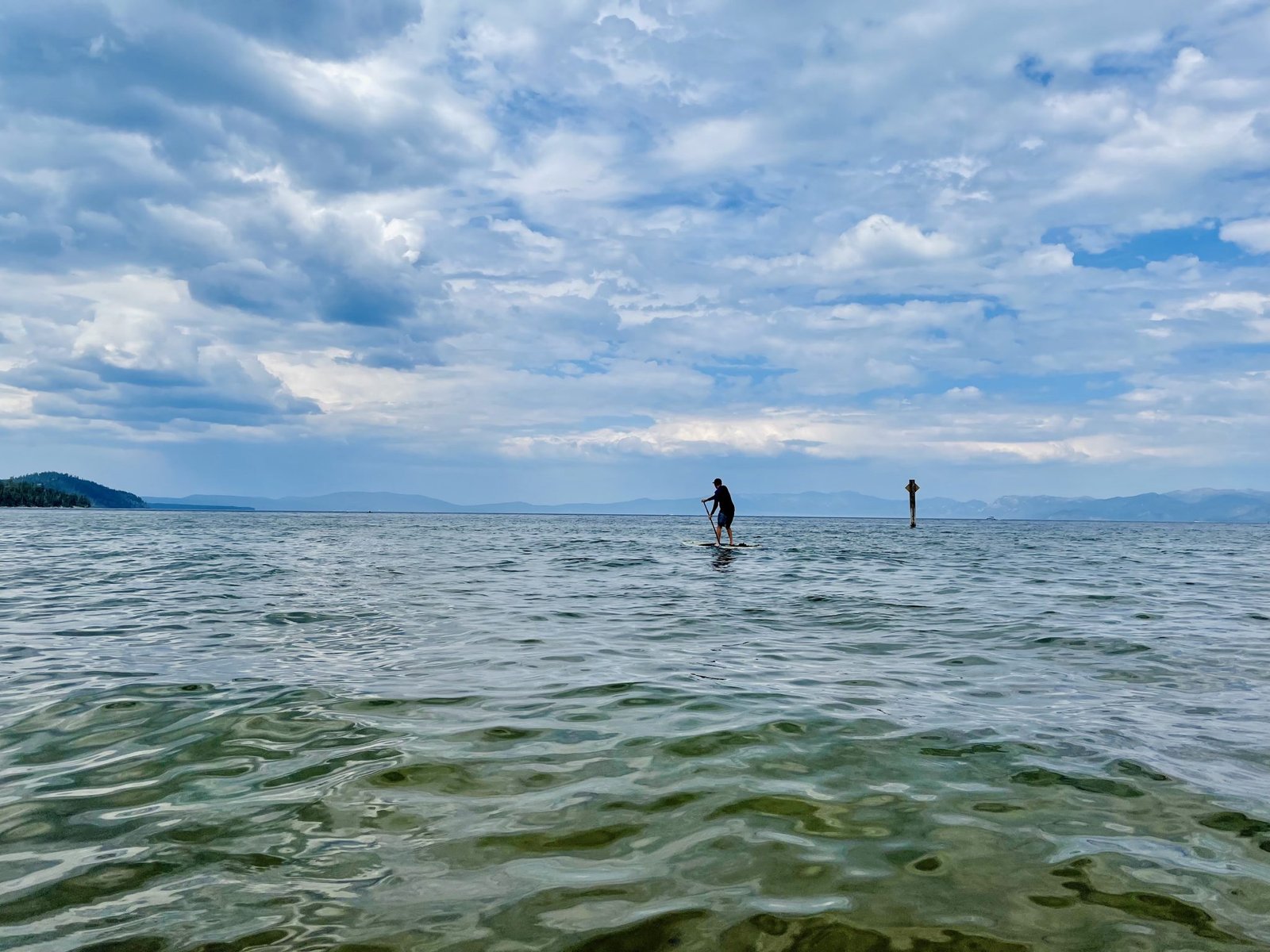
The best place for beginner paddleboarding is flat, sheltered water with little boat traffic, easy access from a beach or ramp, and shallow edges where you can practice falling. Small lakes, protected coves and calm bays on windless mornings are ideal. Avoid open ocean, surf, river current and offshore winds until you have lessons and experience.
Look for these features when choosing a spot:
- Shelter from wind, such as trees or hills on the upwind side.
- Gentle entry, like a sandy beach or low dock, so you can launch without stepping onto rocks.
- Light traffic, away from powerboats, jet skis and busy swimming areas.
- Clear rules, since some parks and lakes require permits or limit where boards can launch.
Wind is the biggest factor for new paddlers. Standing on a board makes your body act like a sail, so even a moderate breeze can make it hard to paddle back. Many beginners aim for very light wind on their first few outings. Check the forecast at weather.gov or your national weather service, and plan to paddle into the wind first so the return trip is easier.
Tip: Offshore winds blow from land toward open water. They can look calm near shore while pushing you steadily away from it. If the wind is blowing out from the beach, stay close in or choose another spot.
How do you stand up on a paddleboard?
To stand up on a paddleboard, start kneeling in the center of the board near the carry handle, place the paddle across the deck, then bring one foot and then the other to where your knees were. Rise in one steady motion with knees soft, back straight and your gaze fixed on the horizon.
Follow these steps in knee deep water:
- Walk the board out until the fin is clear of the bottom, usually about knee deep.
- Climb onto the board on your knees, centered over the carry handle.
- Paddle a few strokes on your knees to feel how the board moves.
- Lay the paddle across the board under your hands for support.
- Place one foot where one knee was, then the other, keeping your feet hip width apart and parallel.
- Stand up slowly, using your legs, not your back, and lift the paddle as you rise.
- Look ahead at a fixed point on the shore rather than down at your feet.
What is the right stance?
Your feet should be parallel, hip width apart and on either side of the carry handle. Keep your knees slightly bent and your weight over the balls of your feet. Stiff legs make every small wobble feel bigger. Soft knees absorb it.
Why does the board feel wobbly?
Wobbles usually come from looking down, standing too far forward or back, or locking your knees. When you feel unsteady, the fastest fix is to start paddling. A moving board is more stable than a still one, much like a bicycle.
How do you hold and use a SUP paddle?
Hold a SUP paddle with one hand on the top grip and the other on the shaft about shoulder width below, with the blade angled forward, away from you. Reach forward, plant the whole blade in the water, pull it back to your feet and lift it out. Switch sides every few strokes to keep a straight line.
A frequent beginner mistake is holding the paddle backward. The blade has a bend in it. That angle should point toward the nose of the board, which gives a cleaner, more efficient stroke.
The forward stroke
- Rotate your torso and reach forward with the blade.
- Bury the whole blade in the water before you pull.
- Pull back by unwinding your torso, not just bending your arms.
- Stop the stroke at your feet, then slice the blade out to the side.
- Repeat on the same side three to five times, then swap your hands and switch sides.
When you switch sides, the hand that was on the grip moves down to the shaft and the lower hand moves to the top. It feels awkward at first and quickly becomes automatic.
Turning the board
- Sweep stroke: Plant the blade near the nose and draw a wide arc out toward the tail. The board turns away from the side you paddle on.
- Reverse stroke: Paddle backward on one side to turn more sharply toward that side, or to slow down.
- Step back turn: A more advanced move where you step toward the tail to lift the nose and pivot quickly. Leave it until you feel confident.
Tip: Your power comes from your core and hips. If your arms and shoulders burn after a few minutes, you are probably pulling with your arms alone. Rotate more and let your legs and torso do the work.
How do you fall off and get back on a paddleboard safely?
Falling off a paddleboard safely means falling away from the board, flat into the water, rather than onto the deck or fin. To get back on, swim to the side, grab the carry handle, kick your legs up behind you and slide onto your stomach, then move to your knees before standing again.
Everyone falls while learning. Practicing a few deliberate falls in warm, shallow water near shore takes the fear out of it.
How to fall
- Push the board away with your feet and fall to the side.
- Aim for a flat fall, like lying back into a pool, rather than diving.
- Keep hold of the paddle if you can, or let it go and retrieve it after you are back on.
- In shallow water, fall flat rather than feet first to avoid striking the bottom.
How to climb back on
- Swim to the middle of the board, beside the carry handle.
- Place the paddle across the deck.
- Grab the handle with one hand and the far edge with the other.
- Kick your legs to the surface and pull yourself across the board on your stomach.
- Turn, move to your knees, collect yourself, then stand up as before.
If you are tired or cold, it is fine to paddle back to shore on your knees. There is no prize for standing the whole time.
How do you stay safe on a paddleboard?
Paddleboard safety for beginners rests on a few habits: wear a life jacket and leash, check the weather and wind, stay close to shore, paddle with a friend or tell someone your plan, and know your limits. Cold water, offshore wind and fatigue cause more trouble than falling off the board itself.
Build these into every outing:
- Tell someone your plan. Share where you are launching, your route and when you expect to be back.
- Check the forecast. Watch wind speed and direction, thunderstorm risk and changing conditions. Get off the water if you hear thunder.
- Respect cold water. Sudden immersion in cold water can be dangerous even for strong swimmers. Dress for immersion and stay close to shore.
- Avoid alcohol. It affects balance and judgment on the water.
- Carry a whistle and a phone in a waterproof case.
- Know the local rules. Some waters have speed zones, launch restrictions or rules about boards near swim areas.
If someone is in trouble in the water, call emergency services (911 in the US, 999 or 112 in the UK, 911 in Canada, 000 in Australia) rather than putting yourself at risk. Reach or throw a buoyant object if you can do it safely from your board or shore.
What are common beginner paddleboarding mistakes?
The most common beginner paddleboarding mistakes are holding the paddle backward, looking down at your feet, standing with locked knees, paddling with only your arms and going out in too much wind. Each one is easy to fix once you know about it, and fixing them makes the sport feel much easier.
| Mistake | What happens | Fix |
|---|---|---|
| Blade angled backward | Stroke feels weak and splashy | Point the blade bend toward the nose |
| Looking at your feet | More wobbles and falls | Fix your eyes on the horizon |
| Locked knees | Every bump throws you off balance | Keep knees soft and slightly bent |
| Arm only paddling | Tired shoulders, slow progress | Rotate your torso and use your core |
| Paddling downwind first | Hard slog back to the start | Head into the wind first |
| No leash | Board drifts away after a fall | Wear a leash every time |
| Standing too far back | Nose lifts and the board stalls | Center your feet on the handle |
How do you build your skills after the first session?
After your first session, build paddleboarding skills by going out often in calm conditions, adding a little distance each time, practicing turns on both sides and taking a lesson from a certified instructor. Short, frequent outings teach balance faster than occasional long ones, and a lesson fixes habits before they settle in.
A simple progression for your first month might look like this:
- First outings: Kneel, then stand, paddle straight lines and practice falling near shore.
- Next few outings: Work on sweep and reverse turns on both sides and switching hands smoothly.
- After that: Try longer loops close to shore, paddling into a light breeze and back.
- Once comfortable: Take a lesson to learn the step back turn, light chop and self rescue in deeper water.
Paddleboarding is also a solid workout. It trains balance, core strength and endurance in a low impact way. If you enjoy it, it pairs well with land based training. Our guide on how to start trail running is a good next step for building leg and cardio fitness, and you can read more about why time outdoors is good for you if you want extra motivation to get out on the water regularly.
How long should a beginner session be?
Many beginners find that an hour or so is plenty for the first few outings. Your feet, legs and shoulders will be working in new ways, and tired muscles lead to more falls. Finish while you still have energy for the paddle back.
Should you buy a board right away?
Renting a few times first lets you try different widths and lengths and work out whether an inflatable or a hard board suits your storage and transport. Once you know where and how often you will paddle, buying becomes a much easier decision.
Frequently asked questions
Is paddleboarding hard for beginners?
Paddleboarding is one of the easier water sports to learn. On calm, sheltered water most beginners can stand and paddle forward during their first session, especially on a wide, stable board. It gets much harder in wind, chop or current, so choose a calm day and start on your knees if you feel unsteady.
Do you need to know how to swim to paddleboard?
You should be able to swim before you paddleboard, and you should always wear a life jacket and a leash. Falling in is part of learning, so being comfortable in the water matters. If you are not a confident swimmer, take a lesson, stay in shallow water and keep very close to shore.
What size paddleboard should a beginner get?
Beginners usually do best on a wide, all-around board with a weight capacity well above their body weight. Wider boards feel more stable while you learn balance. Renting different sizes before you buy is the easiest way to find out what feels steady for your height, weight and the water you plan to paddle.
What should I wear paddleboarding?
Wear clothing suited to the water temperature rather than the air temperature. On warm days, quick drying synthetic layers, a hat, sunscreen and water shoes work well. In cold water, a wetsuit or drysuit is the safer choice. Avoid cotton, which stays wet and cold, and always add a life jacket.
Is a paddleboard or a kayak better for a beginner?
Both suit beginners on calm water. A kayak keeps you seated and handles wind more easily, while a paddleboard gives a higher view and works your balance and core more. If wind or cold water worries you, a kayak may feel more secure. If you enjoy balance challenges, a paddleboard is a fun choice.
Sources and further reading
Featured photo: Sakin Shrestha via Openverse (CC0).