On this page
Geocaching is a real-world treasure hunt: people hide small containers called caches, post their locations online, and others use a phone or GPS device to find them, sign the logbook and put them back. For beginners, all you need is a free geocaching app, a pen and a curious mind. Start with easy, nearby caches and build from there.
It is one of the easiest outdoor hobbies to start, because caches are hidden almost everywhere: city parks, trails, beaches and even parking lots. This guide explains how geocaching works, how to set up, how to choose your first caches, what you will find inside, the etiquette that keeps the game going and how to stay safe while you search.
Key takeaways
- Geocaching uses GPS coordinates to find hidden containers with a logbook inside.
- Start with the official geocaching app or website, a free account and a pen.
- Choose traditional caches with low difficulty and terrain ratings for your first finds.
- Sign the log, put the cache back exactly where you found it and log your find online.
- If you take an item from a cache, leave something of equal or greater value.
- Respect private property, nature and nearby people, and always tell someone where you are going.
What is geocaching and how does it work?
Geocaching is an outdoor game in which players hide containers, called geocaches, and share their GPS coordinates online. Other players navigate to those coordinates with a phone or handheld GPS, search the area, sign the paper log inside and return the cache to its spot. Finds are then logged online so the owner and community can follow along.
Here is the basic loop:
- Someone hides a container with a logbook and publishes its coordinates and a short description.
- You choose that cache on a map in the app or on the website.
- You navigate to the location, which gets you close but not exactly to the cache.
- You search the area using the description and any hint.
- You sign the logbook with your name and date.
- You put the cache back exactly as you found it.
- You log your find online, adding a short note for the owner.
GPS accuracy is often only good to within several yards or meters, especially under trees or near tall buildings. That is why the final search takes some observation, not just following an arrow.
How do you get started with geocaching?
To get started with geocaching, create a free account on the official geocaching website or app, allow location access on your phone, and look at the map of caches near you. Bring a pen, water and a bag for small items. Pick an easy cache close to home for your first search, ideally during daylight.
What do you need for your first geocache?
| Item | Why you need it |
|---|---|
| Smartphone with a geocaching app, or a handheld GPS | To find coordinates and read cache details |
| Pen | Many small caches do not include one |
| Small trade items (optional) | To swap if you take something |
| Water and snacks | Searches can take longer than expected |
| Comfortable shoes | Some caches are off paved paths |
| Phone battery or power bank | Navigation apps use battery quickly |
| Small bag | To carry trade items and any trash you pick up |
You do not need special gear for most beginner caches. If your route goes into the woods, use the basic kit from our walking gear checklist for beginners.
Tip: Download the cache details before you leave home if you will be in an area with poor signal. Some apps let you save caches for offline use.
What do geocache types, sizes and ratings mean?
Geocaches are labeled by type, size and two ratings: difficulty and terrain. Type tells you how the cache works, size tells you what you are looking for, and difficulty and terrain each run on a scale from 1 (easiest) to 5 (hardest). Beginners should start with traditional caches rated 1 to 2 for both difficulty and terrain.
Common cache types
| Type | How it works | Good for beginners? |
|---|---|---|
| Traditional | The container is at the posted coordinates | Yes, best place to start |
| Multi-cache | Visit one or more stages to collect clues to the final location | After a few finds |
| Mystery or puzzle | Solve a puzzle to get the real coordinates | Once you know the basics |
| EarthCache | Learn about a geological feature and answer questions, no container | Yes, if you enjoy learning |
| Letterbox hybrid | Includes a stamp, sometimes requires clues | Sometimes |
| Event | Meetups with other geocachers | Yes, great for learning |
Sizes
Caches range from tiny micro containers, sometimes smaller than a film canister, to large boxes. Small and regular sizes are easiest for beginners, since they are easier to spot and often hold trade items. Micros can be tricky, so save them for when you have a few finds.
Difficulty and terrain
- Difficulty describes how hard the cache is to find or solve.
- Terrain describes how hard the location is to reach, from flat, accessible paths to climbing or boating.
Look at both ratings before you go. A low terrain rating can still involve walking off a path, so read the description.
How do you find your first geocache?
To find your first geocache, choose an easy traditional cache nearby, read the description, recent logs and hint, then navigate to the coordinates. When you are close, put the phone away and look for things that seem out of place: odd stacks of rocks, hollow logs, loose bark or objects tucked under railings. Search gently and patiently.
Step by step:
- Filter the map for traditional caches with difficulty and terrain of 1 to 2.
- Read the description, the recent logs and the attributes, such as whether it is good for kids or available at night.
- Navigate to within a short distance of the coordinates.
- Stop and look around. Think about where you would hide something.
- Search gently. Do not dig, break branches or move large rocks.
- Use the hint if you are stuck. There is no shame in it.
- Once found, sign the log and reseal the container carefully.
- Put it back exactly where and how you found it, with the same cover.
What if you cannot find the cache?
Not every search ends in a find. GPS drift, a hard hiding spot or a missing cache can all be causes. Check recent logs: several “did not find” logs in a row can mean the cache is missing. Log your own “did not find” too. It helps the owner and other players.
What is inside a geocache and what are the trading rules?
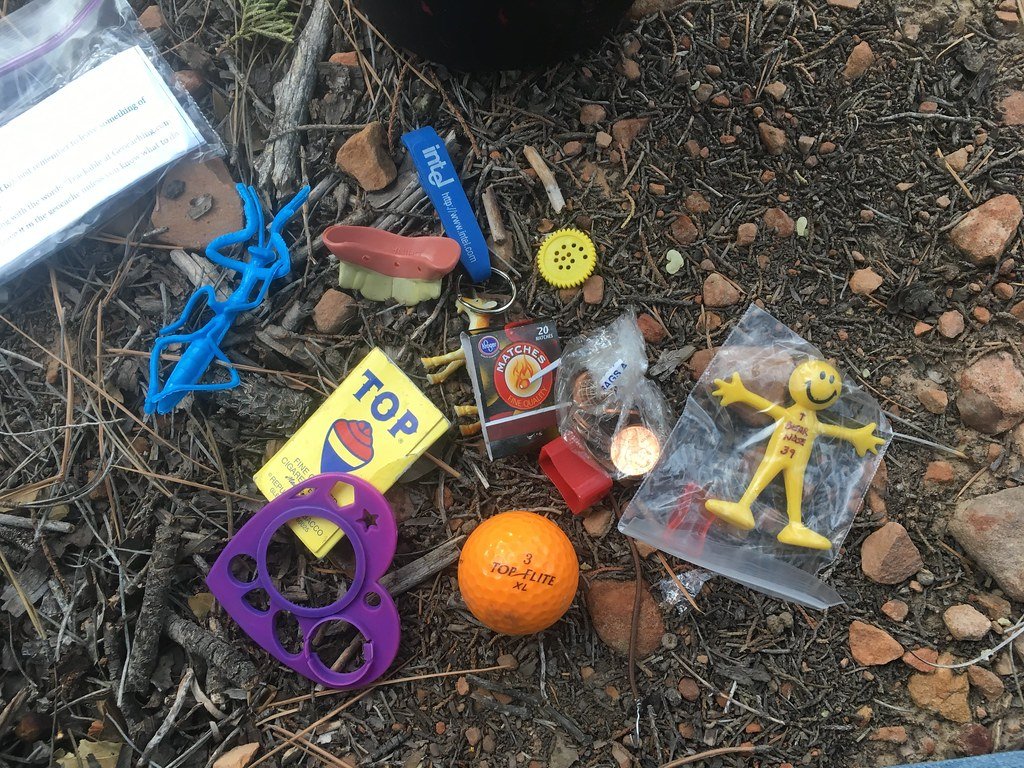
Inside a geocache you will always find a logbook or log sheet. Larger caches often also hold small trade items such as toys, keychains or badges, and sometimes trackables that travel from cache to cache. If you take an item, the common rule is to leave something of equal or greater value.
Trading etiquette:
- Trade fair: leave something of equal or greater value.
- Keep items family friendly.
- Never leave food, scented items, sharp objects, liquids or anything dangerous. Food can attract animals.
- Do not take trackables unless you plan to move them to another cache.
- Signing the log alone is completely fine. You do not have to trade.
What are trackables?
Trackables are tagged items with a unique code, often called travel bugs or geocoins. They move from cache to cache with players, and their travels are tracked online. If you pick one up, log it, read its goal and drop it in another cache within a reasonable time.
What is good geocaching etiquette?
Good geocaching etiquette means respecting the cache, the place and the people around it. Put caches back exactly as you found them, avoid damaging plants or property, be discreet so non-players do not stumble on caches, and log your visits honestly. Many geocachers also pick up litter along the way, a tradition known as Cache In Trash Out.
Etiquette basics:
- Stay on trails where possible and follow local rules.
- Be discreet around non-players, often called “muggles”, so caches are not removed.
- Reseal containers so the log stays dry.
- Do not move a cache to a “better” spot.
- Log finds and problems honestly, including damaged or wet logs.
- Carry out any trash you find. Our guide on how to hike responsibly on busy trails covers trail courtesy more broadly.
- Respect private property and closed areas.
Tip: If a log is wet or the container is cracked, mention it in your online log. The owner can then fix it before the next player arrives.
How do you stay safe while geocaching?
Staying safe while geocaching means choosing caches that match your fitness and terrain comfort, checking the weather, telling someone where you are going and staying aware of your surroundings. Avoid putting your hands into spaces you cannot see, watch for ticks, poison ivy and traffic, and never trespass or take risks to reach a cache.
Safety checklist:
- Check the forecast and daylight before you head out.
- Use a stick or flashlight to check hidden spots before reaching in.
- Watch for traffic near roadside caches.
- Wear long pants in tall grass and check for ticks afterward.
- Learn to recognize poison ivy and similar plants in your area.
- Go with a friend for remote caches and share your plan.
- Turn back if terrain becomes unsafe.
For trail-specific safety, read wildlife safety on the trail. If you head farther out, our guide on how to navigate with a phone app on the trail explains offline maps and battery tips.
Is geocaching good for families and kids?
Geocaching is a great family activity because it turns a walk into a game with a clear goal. Kids enjoy the search, the trade items and signing the log. Choose easy caches with low terrain ratings near parks or playgrounds, keep outings short and let children take turns navigating and searching.
Family tips:
- Pick caches with the “kid friendly” attribute if the app shows it.
- Bring a small bag of trade items your kids chose.
- Plan a short route with two or three caches close together.
- Celebrate the find, but treat a “did not find” as part of the fun.
- Bring snacks and water for everyone.
Geocaching also gives walks a reason, which can help families spend more time outdoors. For more on the benefits, see why time outdoors is good for you.
What are common geocaching mistakes beginners make?
Common geocaching mistakes beginners make include choosing hard caches too soon, relying only on the GPS arrow, damaging the area while searching, forgetting a pen, not putting caches back exactly as found and drawing attention to the hiding spot. Most of these are easy to avoid with a little patience and care.
Avoid these:
- Starting with puzzles or micros. Build confidence with easy traditional caches first.
- Staring at the screen. Once close, look around instead.
- Searching too hard. Never dig, break branches or pull apart structures.
- Forgetting a pen. Many logs do not come with one.
- Misplacing the cache. Put it back exactly as you found it.
- Being obvious. Wait for non-players to pass before retrieving a cache.
- Skipping online logs. Logs help owners maintain caches.
How can you keep going after your first finds?
After your first finds, try new cache types such as multi-caches and EarthCaches, attend a local geocaching event to meet other players, and work toward personal challenges like caching in different parks. Some players eventually hide their own caches, following the official guidelines and getting permission from the landowner first.
Ideas for the next stage:
- Try a multi-cache on a weekend walk.
- Visit an EarthCache and learn about local geology.
- Go to an event to learn from experienced players.
- Combine geocaching with cycling or paddling.
- Hide your first cache once you understand the guidelines.
If you enjoy geocaching, you might like other low-pressure hobbies too. Our list of beginner outdoor activities to try is your next step, and birdwatching for beginners pairs well with slow, observant searching.
Frequently asked questions
Is geocaching free?
You can start geocaching for free. The official geocaching app and website offer a free basic membership that shows many traditional caches near you. A paid premium membership adds more cache types and features, but it is not required to begin. You also need a phone or GPS device, a pen and, if you like, small trade items.
What should I bring when geocaching?
Bring a phone with the geocaching app or a handheld GPS, a pen, water, snacks, comfortable shoes and a fully charged phone or power bank. Small trade items are optional. For woodland caches, add sun protection, a light layer, tick protection and a flashlight to check hidden spots before you reach in.
How do I find a geocache when the GPS is not accurate?
GPS often gets you close but not exactly to the cache. When you are near, put the phone away and look for spots that seem out of place, such as loose bark, rock piles or hollow logs. Read the description and hint, check recent logs, and search gently in widening circles.
Can I take something from a geocache?
Yes, you can take a trade item from a geocache if you leave something of equal or greater value. Keep trades family friendly and never leave food, scented items, liquids or anything sharp. Trackables are different: only take one if you plan to move it to another cache and log it online.
Is geocaching safe for kids?
Geocaching can be safe and fun for kids when adults choose easy caches with low terrain ratings in familiar places, supervise searches and keep hands out of spaces you cannot see. Check the weather, watch for traffic and plants like poison ivy, and check for ticks afterward. Keep outings short and positive.
Sources and further reading
- Geocaching official website for the app, cache maps and hiding guidelines.
- Leave No Trace Center for Outdoor Ethics for low-impact outdoor habits.
- Centers for Disease Control and Prevention for tick prevention advice.
Featured photo: cogdogblog via Openverse (CC0).